
Every winter, the roads around Evansville get coated in salt and brine, and a good share of it follows you home. It drips off the wheel wells, melts into puddles under the car, and sits on the garage floor for days or weeks. Over time that salty water is hard on bare concrete. Here is how road salt damages a garage floor in winter, how a coating helps, and a simple cleaning routine that keeps a coated floor looking good through a Tri-State winter.
How much salt goes on Tri-State roads?
More than most people would guess. The Vanderburgh County Highway Department typically uses 7,000–11,000 tons of salt a winter. The City of Evansville had 6,000 tons of salt and 12 routes ready for the January 2026 storm, and crews pre-treat with brine. Across the river, the Henderson County road department used more than 2,000 tons in one winter and about 200 tons in a mild one. Statewide, INDOT spends $30M–$60M a year on salt.
All of that keeps roads safe. It also means a car parked in an Evansville, Newburgh or Henderson garage carries a steady supply of salty slush inside from late fall to early spring.
When does salt season start and end?
The average first freeze in Evansville is October 26, and the average last freeze is April 7. That is roughly five months when brine and salt can show up on the roads. January is the coldest month, with a mean high of 41.7°F and a mean low of 25.5°F; February averages 46.7°F / 28.4°F and December 45.6°F / 29.5°F. Annual snowfall averages 10.8 inches, so it is not the snow totals that matter here so much as the repeated swings around freezing. INDOT notes that Indiana pavements see “a large number of freezing and thawing cycles each year.”
How road salt damages a garage floor
Bare concrete is porous. Salty water soaks into the surface, and when temperatures swing across freezing, the water in those pores can freeze and expand. Repeated cycles can break down the top layer of the slab, which shows up as:
- Scaling and flaking, where thin pieces of the surface pop off
- Pitting in the tire lanes and where slush drips from the car
- White residue that keeps coming back after washing
- Rough, dusty concrete that is hard to keep clean
Older slabs can be more vulnerable simply because they have had more winters of exposure. The median Evansville home was built in 1961, and Henderson’s median home was built in 1974, so many local garages have seen decades of salt.
Does a garage floor coating stop salt damage?
A properly installed coating seals the concrete surface so salty water sits on top instead of soaking in. That makes it far easier to rinse away and keeps it out of the pores where freeze-thaw damage starts. Both epoxy and polyaspartic systems resist salt well when bonded to a well-prepared slab. A polyaspartic top coat is generally considered tougher against chemicals and abrasion, which is helpful in tire lanes that take the most slush. Compare them in our epoxy vs polyaspartic guide.
A coating is not a cure for damage that is already there. If your slab is already scaled or pitted, it needs to be ground and repaired first. Crack and chip patching typically runs $25–$250, and resurfacing a badly damaged slab typically runs $3–$5/sq ft (2025–2026 estimates). Our concrete floor prep and crack repair page explains what that involves.
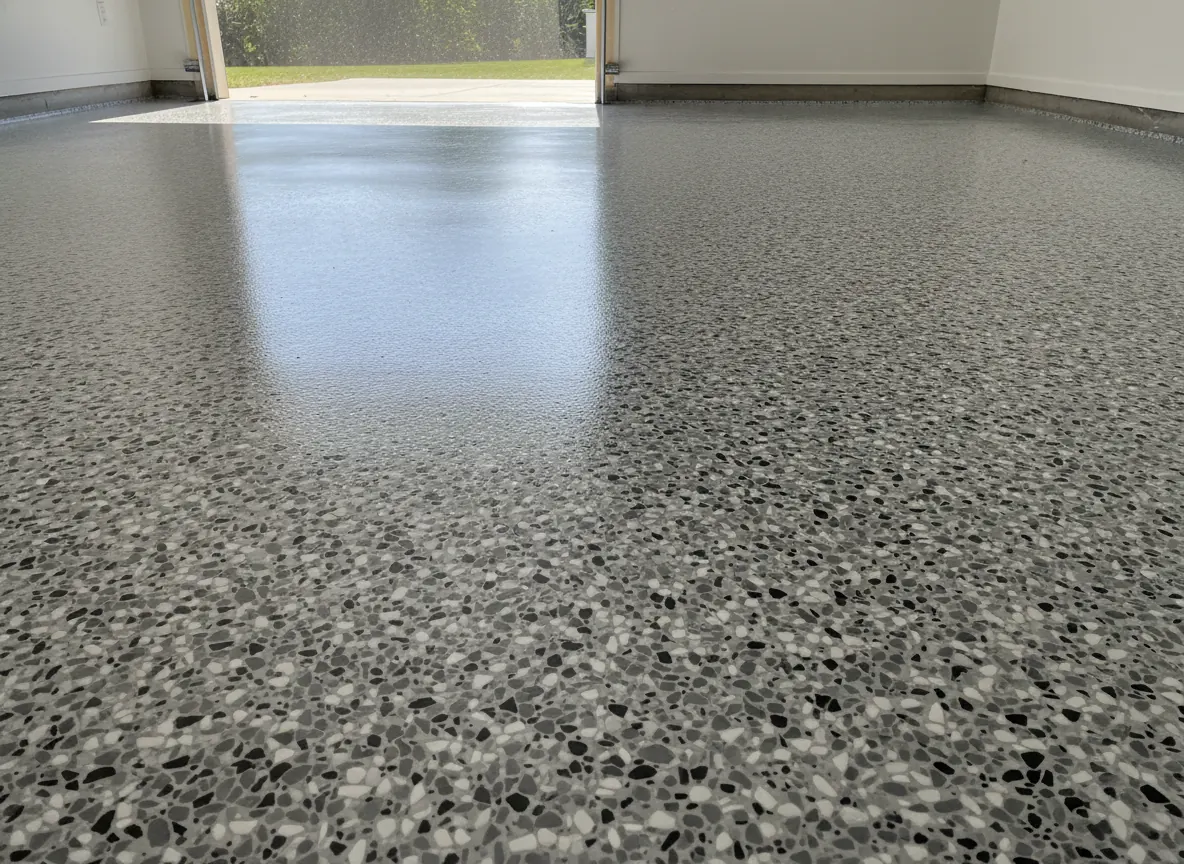
A winter cleaning routine for coated floors
A coated floor makes winter cleanup easy, but salt still shouldn’t sit for weeks. A simple routine:
Squeegee meltwater out often
After a slushy drive, push puddles toward the door or a drain with a floor squeegee. Less standing brine means less residue.
Rinse every week or two in salt season
On a day above freezing, rinse the floor with water and squeegee it out. This removes the film that builds up as brine dries.
Use a mild cleaner for haze
If white haze remains, follow your coating maker’s or installer’s cleaning directions. Avoid harsh chemicals unless the product directions say they are safe for your coating.
Consider containment mats
Raised-edge mats under each car catch slush, but empty them regularly so they don’t become salty ponds.
Do a spring deep clean
After the last freeze (around April 7 on average), give the whole floor a thorough wash and check for any chips that need touch-up.
Flake floors are popular in salty climates partly because the texture and color variation hide dried residue between washes. See our flake garage floor coating page for how those systems are built.
When to install before winter
Coatings need suitable temperatures and humidity to cure, and slab conditions matter as well. With the average first freeze in late October, many homeowners aim to get a floor done before the cold sets in so it is fully cured before salt season. Installers follow product directions for temperature and will tell you whether your timing works. Cure time also affects how soon you can park; see garage floor epoxy cure time.
What it typically costs to protect your floor
Typical installed ranges for a 2-car garage (about 500 sq ft) are $2,500–$4,000 for solid-color epoxy, $2,750–$5,000 for a flake epoxy system and $3,000–$6,000 for a polyaspartic flake system. These are 2025–2026 estimates; your price depends on slab condition. The full table is on the garage floor epoxy cost page.
Want a salt-resistant floor before the next storm? Get a free quote, and we’ll connect you with a local coating installer serving Evansville, Newburgh and Henderson.
Quick answers
Can road salt damage an epoxy garage floor?
A well-bonded epoxy or polyaspartic coating resists salt much better than bare concrete because brine sits on top instead of soaking in. Salt left for long periods can still dull the finish and leave hazy residue, and it can work under chipped or peeling areas. Rinsing and squeegeeing regularly during salt season keeps a coated floor in good shape.
How do you clean salt off a coated garage floor?
Squeegee meltwater out after slushy drives, then rinse the floor with water every week or two on days above freezing. For stubborn white haze, use a mild cleaner that your coating maker or installer approves. Avoid harsh chemicals unless the product directions say they are safe, and do a full deep clean in spring.