
Polyaspartic Garage Floor Coating in Evansville
Polyaspartic is the fast-curing, UV-stable coating many homeowners ask about. It is a great fit for a lot of garages, but not every one, so here is the honest version.
Get a Free QuoteThe problem: downtime, yellowing and a short weather window
A traditional epoxy floor can take the garage out of service for days. That is a real cost when the garage is where the car lives in a Tri-State winter. The average first freeze in Evansville is around October 26 and the last is around April 7, and January's mean low is 25.5°F. Cold slabs slow many coatings down, so the comfortable install window can feel short.
Sunlight is the other issue. Many epoxies can amber or yellow with UV exposure. A garage with the door open on summer afternoons, or one with a west-facing door, may show it near the threshold first. Homeowners who want a light or bright color often care about that.
The solution: what polyaspartic does well
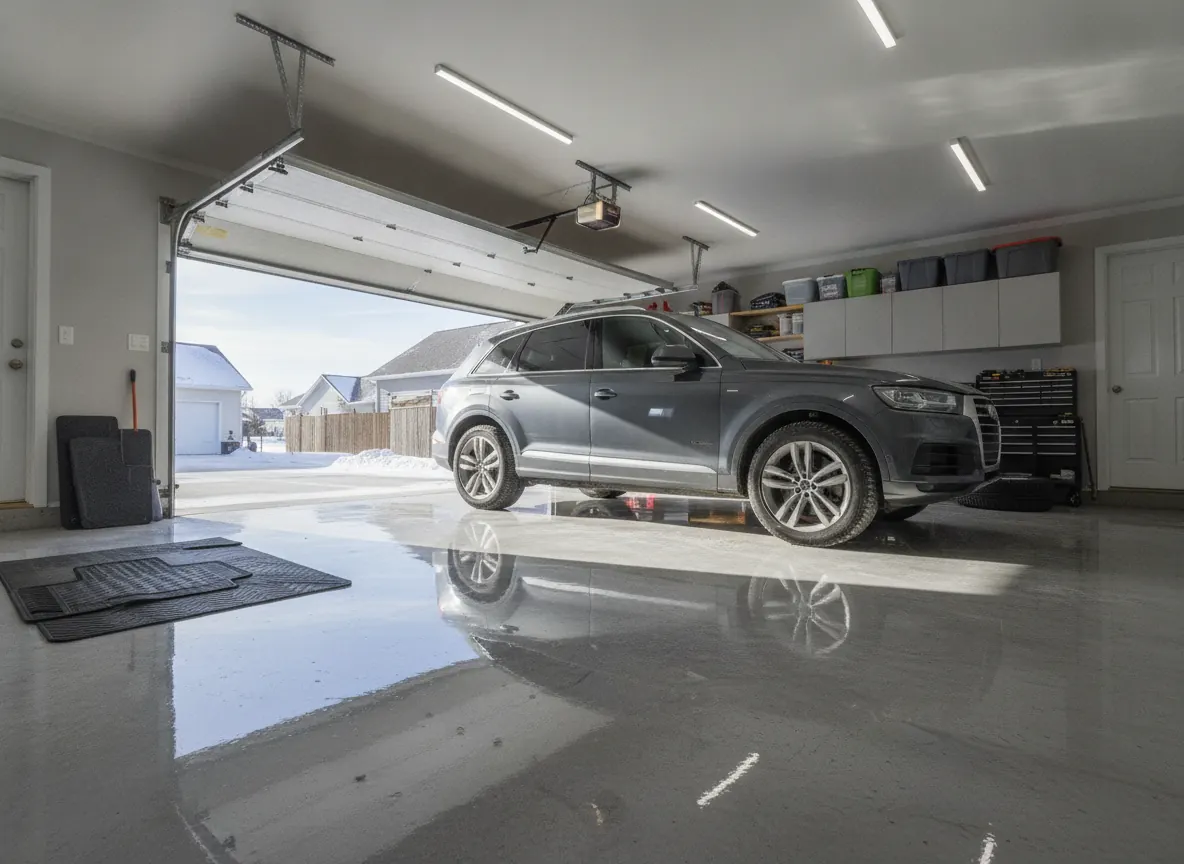
Polyaspartic is a type of polyurea coating. In garages it is most often used as a full flake system or as the clear topcoat over an epoxy or polyaspartic base.
- Fast cure: many systems can be installed and walkable within a day, with vehicles back sooner than a typical epoxy job. Exact times depend on the product and conditions.
- UV stability: aliphatic polyaspartic topcoats are designed to resist yellowing in sunlight.
- Cooler-weather flexibility: many products are made to cure across a wider temperature range than standard epoxy, which can stretch the season.
- Durable wear layer: a hard, abrasion-resistant clear coat over flakes.
The honest trade-offs vs epoxy
Polyaspartic is not automatically "better than epoxy." It is different, and the differences cut both ways:
- Price: a polyaspartic flake system typically runs $6–$12 per sq ft versus $5.50–$10 for a flake epoxy system.
- Short working time: fast cure means the installer has minutes, not an hour, to spread it. It rewards an experienced crew and is a hard product to DIY well.
- Prep still decides everything: a fast coating on a poorly ground slab fails just as fast. Diamond grinding is still required.
- Build: epoxy base coats are often used to build thickness and fill minor surface texture, which is why many hybrid systems use an epoxy base under a polyaspartic top.
For a side-by-side look, read epoxy vs polyaspartic garage floors and garage floor epoxy cure time. If you prefer the classic route, see flake garage floor coating.
How a polyaspartic floor is installed
The steps look a lot like any flake floor, but they move faster. Our process page explains each one.
Assess and measure
The slab is checked for moisture, cracks and old coatings, and the square footage is measured.
Diamond grind and repair
The surface is ground and cracks are filled. This cannot be skipped. See concrete prep.
Base coat and flakes
A base coat (polyaspartic or epoxy, depending on the system) is applied in sections and flakes are broadcast.
Scrape and clear topcoat
Excess flake is removed and a UV-stable clear topcoat seals the floor, with optional anti-slip grit.
Return to service
Follow the installer's written times for foot and vehicle traffic, and keep the garage ventilated per product directions.
Typical polyaspartic pricing
Typical installed ranges, 2025–2026 (estimates only): a polyaspartic flake system runs about $6–$12 per sq ft, or roughly $1,500–$3,000 for a 1-car garage, $3,000–$6,000 for a 2-car and $4,500–$9,000 for a 3-car. Typical lifespan for polyaspartic is 10 to 20+ years with good prep. See every system compared on the garage floor epoxy cost page, then request a free quote for a price based on your slab.
Polyaspartic Coating FAQ
Is polyaspartic better than epoxy for a garage floor?
Neither is better for every garage. Polyaspartic cures faster and resists yellowing in sunlight, which suits homeowners who need the garage back quickly or want a light color. Epoxy usually costs less and builds thickness well. Many installers combine them, with an epoxy base and a polyaspartic topcoat. Your slab and budget decide the right fit.
How long do polyaspartic garage floors last?
As a typical industry figure, a professionally installed polyaspartic floor lasts about 10 to 20 years or more. Actual life depends mostly on surface prep, coating thickness and how the garage is used. Hot tires, dragged equipment and moisture coming up through the slab shorten any coating's life, so ask how the installer handles each one.
Can I DIY a polyaspartic coating?
Some DIY polyaspartic products exist, but the short working time makes them hard to apply evenly without experience. Proper prep also needs a diamond grinder. If you try it, work in small sections, ventilate well and follow the product directions exactly. Our DIY kit vs professional guide covers the trade-offs in more detail.
Can polyaspartic be installed in cold weather?
Many polyaspartic products are formulated to cure at lower temperatures than standard epoxy, which can extend the season in the Tri-State. Each product still has minimum slab and air temperatures listed by the maker. Your installer should check the slab temperature on install day and follow the product's limits.
How much more does polyaspartic cost than epoxy?
Using typical 2025–2026 installed ranges, a polyaspartic flake system runs about $6 to $12 per square foot, while a flake epoxy system runs about $5.50 to $10. For a 2-car garage that is roughly $3,000 to $6,000 versus $2,750 to $5,000. These are estimates, and an on-site look sets the real price.
Ready for a garage floor that cleans up in minutes?
Free, no-pressure quotes across Evansville, Newburgh, Henderson and the Tri-State.