
Once a new floor coating goes down, almost every homeowner asks the same thing: when can I get my garage back? It is a fair question. The garage is where the cars, the freezer, the bikes and the trash cans live, and moving all of it into the driveway is not something anyone wants to do for long.
The honest answer is that dry time depends on three things: the coating chemistry (traditional epoxy versus polyaspartic), the specific product, and the temperature and humidity in your garage while it cures. Below we break down the typical ranges and explain how the Tri-State climate shifts them. Treat every number here as a general, product-dependent range, and always follow the manufacturer's directions for the exact system on your floor.
Dry to the touch, walk-on, drive-on and full cure: four different milestones
“Dry” means different things at different stages, and mixing them up is how people end up with tire marks in a brand-new floor.
- Dry to the touch: the surface no longer feels tacky. It is still soft underneath and easy to scuff.
- Walk-on (light foot traffic): you can walk across it in clean socks or soft shoes. No dragging, no heavy items.
- Drive-on: the coating is hard enough for vehicle weight and the twisting force of turning tires.
- Full cure: the coating has reached its full hardness and chemical resistance. Until then it is more vulnerable to spills, hot tires and chemicals.
How long epoxy takes to dry (typical ranges)
Traditional 100% solids or high-solids epoxy is a slower-curing material. That slow cure is part of why it bonds well and self-levels, but it means more waiting. As a general guide, many epoxy garage systems allow light foot traffic somewhere around 12 to 24 hours after the final coat, vehicle traffic after several days (often in the range of 3 to 7), and reach full cure in about a week or so. A multi-coat epoxy floor, such as a base coat, flake broadcast and clear topcoat, adds waiting time between each coat as well.
Water-based DIY epoxy kits often list their own schedule, and it varies a lot from brand to brand. If you are weighing a kit against a professional install, our post on DIY epoxy kits vs professional installation covers the trade-offs.
How long polyaspartic takes to dry (typical ranges)
Polyaspartic coatings were developed partly to solve the downtime problem. They cure much faster than epoxy, which is why many installers can grind, coat and topcoat a two-car garage in a single day. Typical ranges are walk-on within a few hours and drive-on often within about 24 to 48 hours, with full cure following over the next several days. Some products are faster, some slower. The fast cure also has a trade-off: the material has a short working time, so it is harder for a first-timer to apply well.
If you are deciding between the two chemistries, read epoxy vs polyaspartic for garage floors or see our polyaspartic garage floor coating page.
| Milestone | Traditional epoxy (typical) | Polyaspartic (typical) |
|---|---|---|
| Walk-on | About 12–24 hours | A few hours |
| Drive-on | Several days (often 3–7) | Often 24–48 hours |
| Full cure | About a week or more | Several days |
General ranges only. Cure times are product-dependent and change with temperature and humidity; follow the manufacturer's directions and your installer's instructions.
How Evansville temperatures change cure time
Coatings cure through a chemical reaction, and that reaction slows down when it is cold. Most product data sheets list a minimum slab and air temperature for application, and cure times are usually quoted at a moderate room temperature. A garage below that range will take noticeably longer.
That matters here. NWS normals for the Evansville area put the January mean high at 41.7°F and the mean low at 25.5°F, with February (46.7°F / 28.4°F) and December (45.6°F / 29.5°F) not much warmer. The average first freeze arrives around October 26 and the last freeze around April 7. An unheated garage slab in those months can sit well below the temperature many products want, and it stays cold long after the afternoon air warms up.
Summer brings the opposite issue. July averages a high of 88.6°F, and the area sees about 41 days a year at or above 90°F. Heat speeds up the reaction, which shortens the working time in the bucket and on the floor. Installers often start early in the morning on hot days so the material does not set up before it can be spread evenly.
How Ohio Valley humidity affects drying
Humidity is the other big variable. The Evansville area has a humid subtropical climate, and the muggy stretch typically runs from about May 10 to October 13, with July averaging 29.3 muggy days. In late July 2025, NWS reported dewpoints from the mid-70s to the low 80s.
High humidity can slow curing and, with some epoxies, can leave a cloudy or greasy film on the surface (often called blushing or amine blush). Condensation is a bigger risk: if the slab is cooler than the dewpoint, moisture can form on the concrete before or during application, which can hurt adhesion. That is one reason a good installer checks slab temperature against the dewpoint, not just the air temperature, and why moisture in the slab itself is tested before coating. Our guide to grinding and prepping a garage floor before epoxy covers moisture tests in more detail.
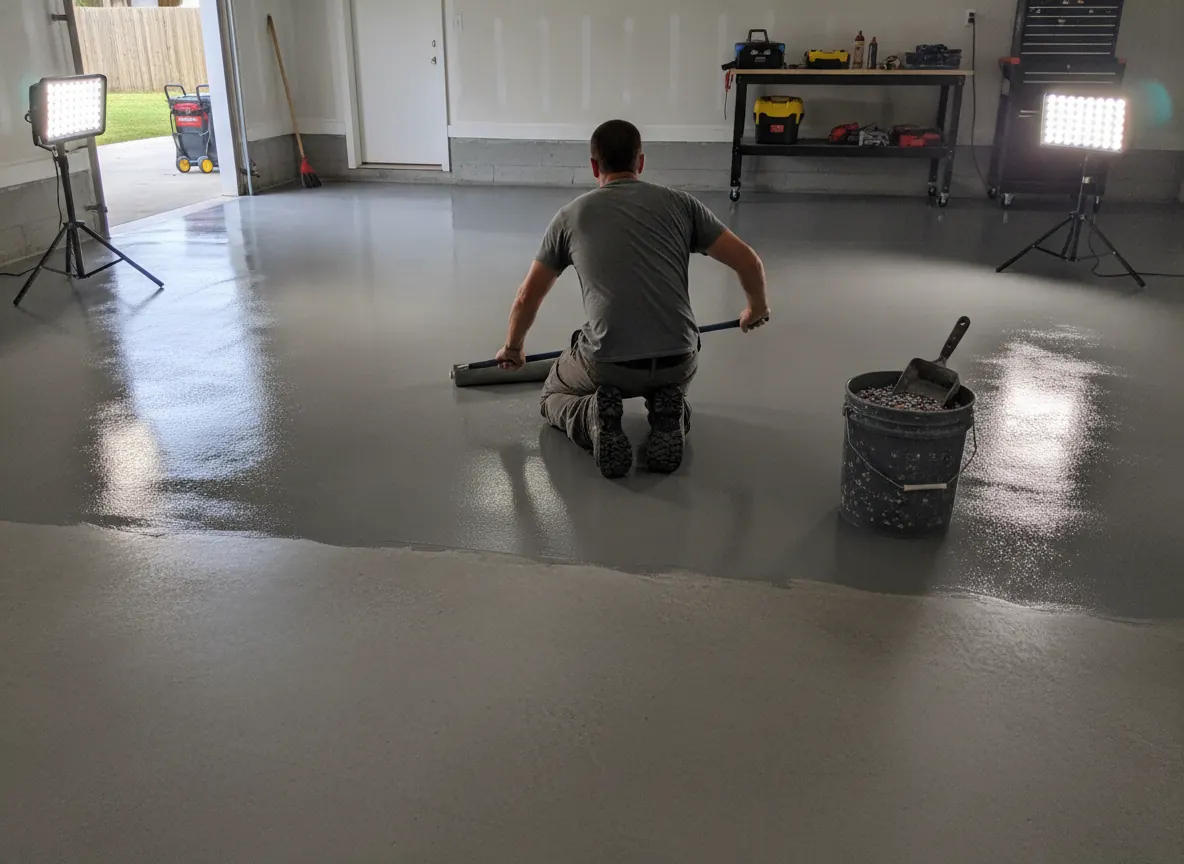
Tips to protect a fresh floor while it cures
- Keep pets, kids and visitors out until the walk-on time has passed.
- Ventilate during and after application, and follow the product's safety directions.
- Wait the full drive-on time before parking, and longer in a cold garage.
- Hold off on putting back heavy shelving, toolboxes or anything with sharp feet until closer to full cure.
- Avoid spilling chemicals, oil or brake fluid on the floor until it is fully cured.
- In winter, wipe off slush and road salt before it sits on a newly coated floor. Our post on road salt and garage floor coatings explains why.
Hot tires deserve special mention. Parking a car that just came off the highway on a coating that is not fully cured is a common cause of hot tire pickup, where the tire lifts or marks the coating.
So when can you use your garage again?
For most homeowners, plan on being without the garage for at least a day with a fast-cure polyaspartic system and for most of a week with a traditional epoxy system, longer if the work happens in cold weather. Your installer should tell you the exact walk-on and drive-on times for the product they use, and those instructions win over any general guide, including this one.
Want to know which system fits your schedule and your garage? See typical prices on our garage floor epoxy cost guide, walk through how an install works, or get a free quote and an installer can look at your slab, the season and your timeline before recommending a system.
Quick answers
Can I park in my garage the day after an epoxy floor goes down?
Usually not with a traditional epoxy system. Most epoxy floors are ready for light foot traffic within roughly a day, but vehicles typically wait several more days, and some products ask for a week. Fast-curing polyaspartic systems are often drivable sooner. Your installer should give you the exact wait time printed on the product they use, and it is worth following it.
Does a fan or space heater speed up epoxy curing?
Gentle airflow helps with ventilation and can help moisture and fumes clear, but do not blow air directly across a wet coating, which can kick up dust. Some products allow added heat and some warn against it, especially open-flame heaters. Check the manufacturer's directions or ask your installer before adding heat or fans in a cold or humid garage.